

Back in my Long Island days, which ended in late 2017 when I migrated to coastal North Carolina, I wrote a series for Reefs.com titled Long Island Collecting Log. It was a way of documenting and sharing my endeavors into one of my life-long passions: searching for out-of-range tropical marine fishes in the waters of Long Island, NY. Naturally, I continue that pastime here in North Carolina, where I am hundreds of miles closer to the Gulf Stream and the diving season is several months longer. Although the primary reason for my move was an exciting job opportunity, the prospect of new and more fertile collecting grounds certainly weighed into my decision. During my last few years in NY, the abundance and diversity of tropical strays in our area was at an all-time low (By “all-time” I mean, my lifetime). I’m not saying that had anything to do with my decision to move, but it certainly didn’t help the case for staying. As I read dire warnings from climate scientists about melting ice caps causing the Gulf Stream to shut down, I thought: Maybe this is it. Maybe the gilded of age of angelfishes and tangs and more butterflyfish than you can count is a thing of the past, and their absence is just a sign of the slowing current system.
Now, seven years into my North Carolina adventure, I’ve had the pleasure of visiting some of those deep offshore reefs where many of the Long Island strays likely originate by way of eggs and larvae. I’ve explored our inlets and bays in search of wayward tropicals and found that they show up as early as April and sometimes hang on well into January. Interestingly, the species composition of inshore strays is much different here. Although jacks, snappers, and grunts are common inshore during the summer, many of the colorful reef species I used to find in New York are practically non-existent in the inlets and bays I’ve explored so far. It’s curious because those same species are relatively abundant in the tropical communities that can be found just 20-40 miles out.
In the summer of 2023, I started hearing from some of my Long Island friends that it was turning out to be an exceptional year for reef species. Blue angelfish sightings on almost every dive and deep-water bigeyes coming up in seine nets all along the south shore. My friend, Chris Paparo (@fishguyphotos) was sending me pictures and videos of fishes I hadn’t seen in the northeast for years. Then, even more surprising, two new range records: a yellowtail reef fish, Chromis enchrysura, and a longfin damsel, Stegastes diencaeus, both from under the Ponquogue bridge within a few days of each other. I wanted so badly to get up there for a dive, but my schedule didn’t cooperate. Thankfully, Chris was kind enough to send me a couple of French angelfish which are now on display at the Carteret Community College Aquaculture Lab.
The following year, as the summer of 2024 got underway, I was able to persuade Chris Paparo and Noel Heinsohn to come down and do some diving with me on some of the deep reefs off the coast of North Carolina. Chris is currently the Manager of the Stony Brook University Marine Lab and Noel is a Curator at the Shedd Aquarium in Chicago. They are two of my favorite diving and fish collecting buddies from my Long Island days and I was excited to show them some of these fascinating subtropical ecosystems.
Just a few weeks after those adventures, I started receiving reports from Chris, as well as other fishy friends on social media, that the tropical scene on Long Island was really heating up. It was looking like it might be even better than 2023. At one point, in a message to me, someone used the term “a school of blue angels.” A few weeks later I received an email from a friend with a photo of a fish he had caught in Moriches Bay. I couldn’t believe my eyes. It was a rock beauty angelfish (Holacanthus tricolor). This was a range record for the species and another new species record for New York State. Although I’m well versed in the basic principles at work with the tropical stray phenomenon, I’m at a loss when it comes to explaining how and why we see such vast swings in the abundance and diversity, but one thing was clear: I needed to plan a trip to Long Island before the 2024 season wrapped up. I got my calendar out and checked with my two closest travel companions: my son, Finn and my friend Carrie, and we started to put a plan together. We found a weekend in mid-September that worked for all of us while the water temperature SHOULD still be warm enough to support the species we were targeting. Now we just needed the weather to cooperate.

Photo by Peter Priolo
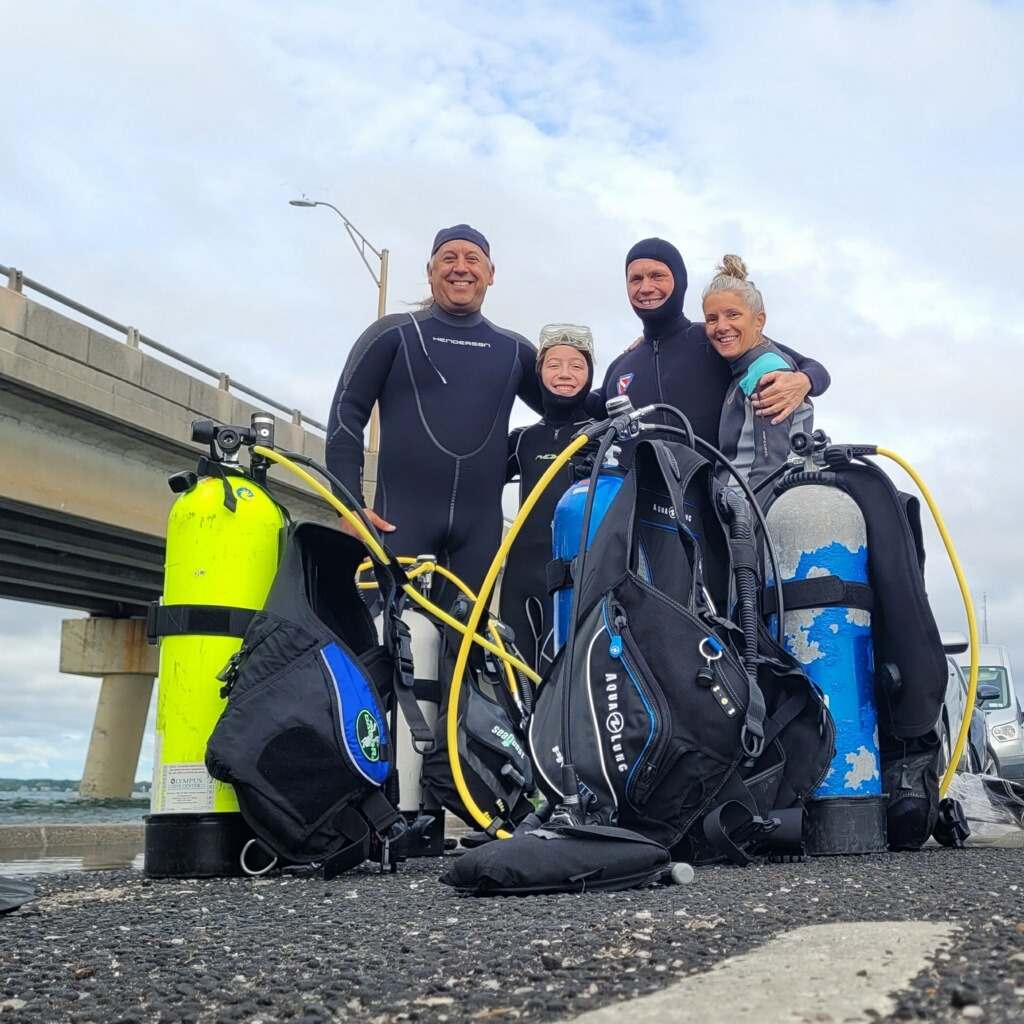
As the date approached, we made plans with old friends for dinners, beers, catching up, and of course, diving. We wanted to make sure we had two full days for excursions while minimizing absences from school and work, so we made the decision to leave on a Thursday evening and drive through the night. That would give us the entire day Friday to plan a dive. Of course, shore diving on Long Island involves a very short window of time as you can only hope to be in the water during slack tide – the period between incoming and outgoing water when there is minimal current.
Our first stop (not including gas fills) was at 4:00am in Brooklyn, to hand off some Berghia verrucicornis to Randy Donowitz for his tanks at Pratt Institute, after which we got right back on the road and made it to Calverton, on the other end of Long Island by 5:30. We had arrived at the house of Chris and Candace Paparo a bit earlier than expected, so to avoid waking up the whole house, we went on a quick breakfast run and let them sleep for another half hour. After refueling on bagels and coffee, we consolidated all our dive gear into Chris’ truck and headed to the Ponquogue Bridge in Hampton Bays. We arrived about an hour before slack tide and just in time to get the last available parking spot on the old bridge-turned-fishing pier, so we had plenty of time to evaluate conditions and assemble our gear. It was an average day at this site: about 6ft of visibility and 68F water temperature. As we split off with our respective buddies, Finn and I headed out along the giant cement pilings of the new bridge, while Chris and Carrie explored the wooden pilings and rock piles under the old bridge. We saw the standard fare of horseshoe crabs, lady crabs, cunners, tautogs, and black seabass, as well as the occasional spotfin butterflyfish, bicolor damselfish, and snowy grouper. We also saw three small blue angelfish, which I caught and bagged. We got out after about 20 minutes because Finn’s 3-mil wetsuit was not sufficient for the chilly water. I was happy with the three angels, but overall, it wasn’t the tropical paradise I was anticipating based on the reports. While everyone was organizing their gear, I jumped in for a little snorkeling and managed to bag three more angels. It was noon and having been awake since early the previous morning, we were starving and deliriously tired. We went to a favorite pizza joint in the town of Southampton where we were met by a cherished old friend, Howard Reisman. Howard is a retired professor of marine and fisheries biology at Southampton College, where many of my closest friends got their start in marine science. I first met him about 35 years ago through our shared lifelong passion: tropical fishes in Shinnecock Bay. While we waited for our pizza, Finn promptly fell asleep in his seat and the rest of us reminisced about the good old days of fishing, fish collecting, and school. Over lunch, Chris and Howard presented me with a book that was decades in the making: Marine Fishes and Fisheries of New York, featuring photos by Chris and a lifetime of knowledge and research by Howard. After having them both sign it, I moved it safely away from the coming storm of pizza grease, woke Finn up by holding a garlic knot under his nose, and we devoured our pizza.
After lunch, the food coma, piled on top of 34 hours awake, 12 hours of driving, and a cold-water dive was catching up with us. It was hard to think about anything but a shower and bed. But it was still early afternoon and we had very limited time. Additionally, a cold front was moving in, so Saturday was sure to be considerably colder and windier. We needed to make this day count. As we stood in the parking lot calculating our next move, I noticed that I had several text messages from a fellow fish collector (Michael Zambardino). He was out on the other side of the bay from where we were diving that morning. Geographically, it wasn’t a site I would have considered, as it was much farther from the inlet than my usual productive spots, and it looked like a place where the water would be shallow and stagnant. Michael was fishing with a rod and reel on that day, but looking down into the water, he could see what appeared to be a lot of tropical fish. The gist of his text messages was: “You better get down here, now!” That was all I needed to hear. We piled in the truck and made our way to the site.

To ensure we wouldn’t run out of steam before running out of daylight, we made a quick pit stop at the Beach Bakery in Westhampton Beach for coffee and some of the world’s best pastries. Thankfully, the sweets didn’t weigh us down too much and we were able to muster the energy to get back in the water. When we arrived at the site, Michael was waiting for us. He motioned to the edge of the dock as if to say: “Go. See for yourself.” I peered down at the bulkhead and within seconds, I spotted the unmistakable electric blue, bright white, and yellow of a juvenile blue angelfish. Then another. And another. In all my years of diving and snorkeling, I had never seen angelfish so close to the surface. My heart was racing. It didn’t seem real. As my brain was attempting to process what I was seeing, it occurred to me why they were at the surface. There were so many of them along this bulkhead that, given their territorial nature, the ones down deeper were chasing others out of their normal, comfortable depths. I couldn’t suit up fast enough. There was no point diving. We grabbed snorkeling gear and jumped in as fast as we could. I handed Finn my GoPro and asked him to get as much video as possible while I swam the perimeter for a quick survey before putting my net into action. The first thing I noticed was that the entire bulkhead was covered in a colony of encrusting bryozoans that formed a structure like rigid folded sheets. The folds formed thousands of small crevices that were perfectly sized for these fish to duck out of view. Upon opening my eyes following the initial plunge, there were no angels in sight, but as I floated quietly, scanning the surface in front of me, they began to emerge. The longer I sat there, the more of them came out of hiding. And they were large – probably 2-3 times the size of the ones we had seen at the bridge. Within about a minute, I started seeing territorial interactions between them. From where I was floating, I could see at least 20 angelfish. I’d never seen anything like this. Well, not in real life anyway. I have had recurring dreams like this – where I’m snorkeling in a familiar, but unlikely spot and suddenly there are tropical fish everywhere. It’s safe to say that this spectacle exceeded all of those dreams.

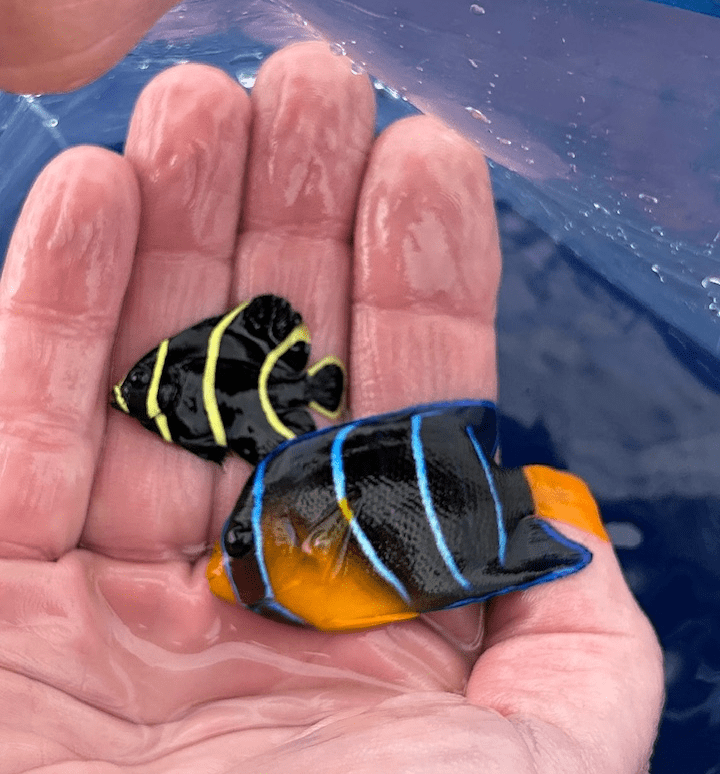
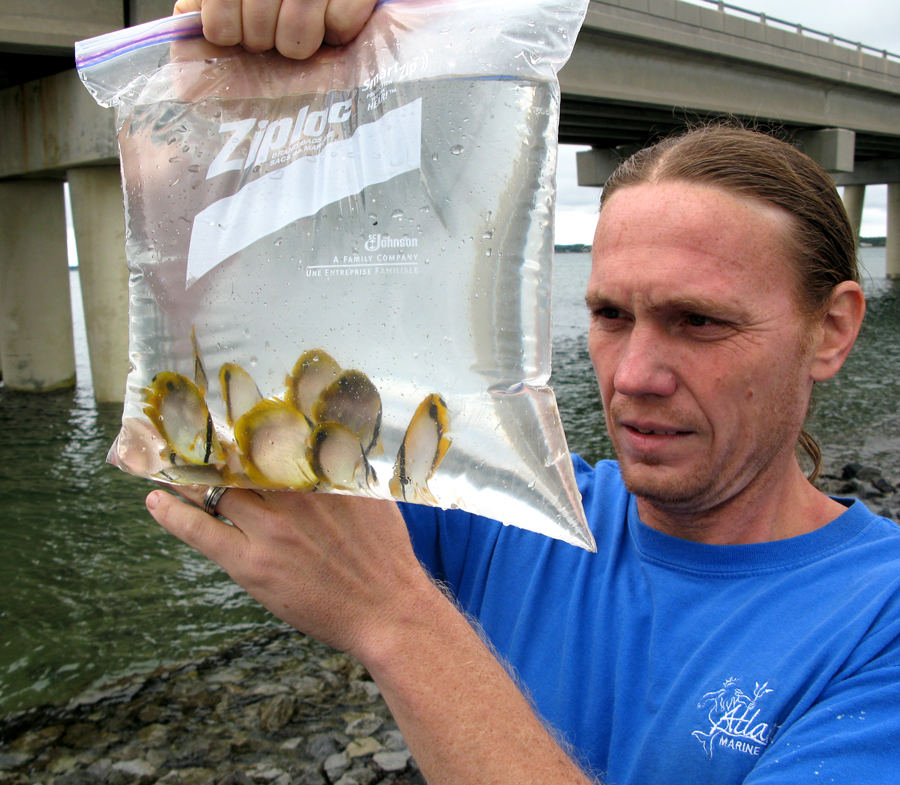
I decided to swim to one end of the dock, then turn around and snorkel the entire length to try to get a rough count. Chris and Finn were busy getting videos and photos, so I gave them both a wide berth as I passed. My attempt to count was futile because most of the angelfish saw me before I saw them and they would duck into their crevices before I spotted them. As I proceeded from the west, to the east end of the bulkhead, I allowed my brain to register some of the other species that were sharing this habitat. There were feather blennies, spotfin and foureye butterflyfish, bicolor and cocoa damselfish, and of course, the ever-present cunner, one of two wrasses that are native to Long Island. Occasionally, I would hold my breath and dive down the 8-10 feet to the bottom. Where the bulkhead met the sand, I would periodically see a young grouper. Although I’ve recorded more than a dozen grouper species on Long Island, on this day it was all scamps and snowy groupers. There were numerous other native species as well, but I’ve already far exceeded my intended word count for this article, so they will go unmentioned. When I got to the eastern most corner of the bulkhead, I did one last dive to the bottom and was rewarded with my next big thrill of the day: A tiny French angelfish, doing its little undulating dance between the bulkhead and the corner piling. It was time for me to snap out of my euphoric trance and start catching fish. In a few weeks, these guys would succumb to the cold, and although there was no way I could take them all, there was also no point in not taking all I could carry home. I estimated that number to be around 10. I took a Ziplock bag out of my pocket, positioned my vinyl net, and got to work. I started with the French angel, then moved onto blues. I was experiencing a new kind of restraint. I had never seen a stray angelfish without at least trying to catch it, but since there were so many, I could afford to pass over most of them. This meant holding out for the largest specimens because they would be better suited to handle the stress of the capture and transport. And more importantly, it meant that I could examine each one a little more closely to see if any of them were, in fact, queen angelfish. As small juveniles, the two are very similar. Most of the distinguishing characteristics used to identify them as adults and larger juveniles are not yet present on individuals of this size. But there is one reliable trait. The second and third vertical white bands on a queen angel are deeply curved, whereas those same bands on a blue angel are nearly straight. To complicate the issue, wherever the two species occur, there is hybridization between the two and their hybrids will have characteristics of both species. I spent the next forty five minutes searching for individuals with curved lines, grabbing the occasional extra robust blue along the way. When my bag was filled with my target number, including two that were likely queens, or possibly hybrids, I noticed that I was shivering uncontrollably. Reluctantly I climbed out of the water to find the rest of the gang was already out and fully dry.

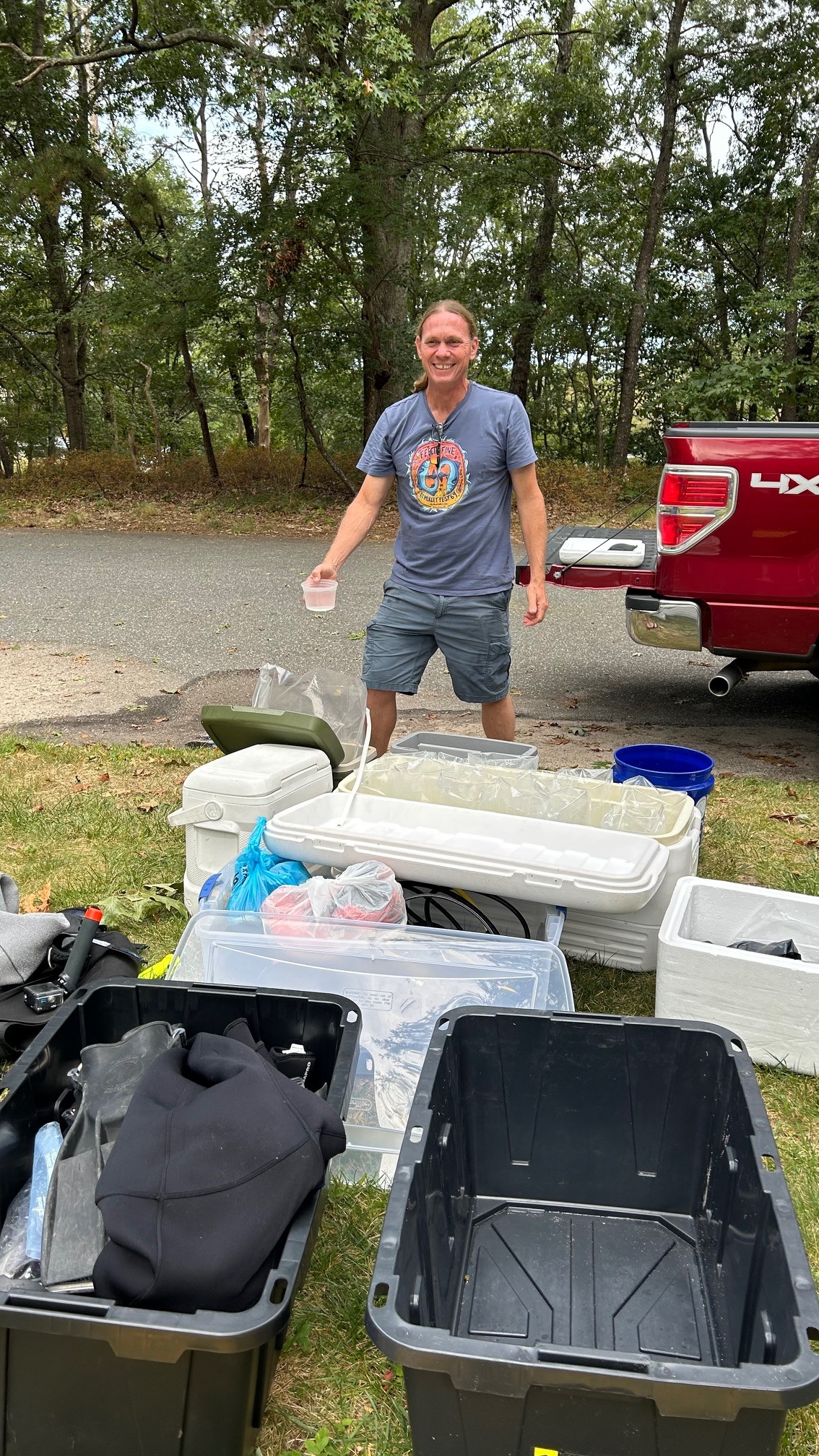
After getting the catch temporarily housed in coolers and bins at the Paparo house, we met up with old friends for beers and dinner and decided to wait until morning to plan out the following day. With a cold front moving in overnight our options would be limited. Eventually, we got to bed after one of the longest waking stretches of my life. We were happy to take things a bit more slowly in the morning, given the cold gray weather. The Paparos served us a hearty breakfast featuring sausage made from a variety of wild game. After breakfast, we took a vote and shockingly, not everyone was eager to get back in the water. So we decided to split up for the day. Candace, Carrie, and Finn set out for some land-based adventures while Chris and I returned to the angelfish dock with SCUBA gear and cameras. We arrived around 10am. Despite the less-than-perfect weather, there were a few people fishing at the dock. As always in these situations, we took a few minutes to speak to the fishermen and explain that we were going to be diving around the dock and we assured them that we would stay clear of their gear. These friendly conversations go a long way toward avoiding conflicts later. As usual, they were interested in what we were doing and had a lot of questions for us. One of them told us that there were two guys snorkeling there earlier who left with a couple of buckets containing 50-100 angelfish. I had to wonder where they all ended up. I assumed they were planning to sell them. I wanted to be annoyed by that thought, but there was no logical reason to be. These fish were all doomed.

We assembled our gear and got in the water. Although conditions were not quite as nice as the day before, we managed to stay in for almost two hours getting photos and video. Naturally I couldn’t resist grabbing a few more fish while I was down there, including a foureye butterflyfish, and a couple of more angels (one queen and one French). As we packed up our gear and headed back to Chris’ house for one last Barbecue I found myself reflecting on my last forty something years of tropical fish collecting. I was 13 years old the first time I visited Shinnecock Bay and encountered tropical strays. Since then, there have been good years and bad years for them. There have also been terrible years and spectacular years. But nothing compares to what I witnessed at that single dock on those two days in September 2024.
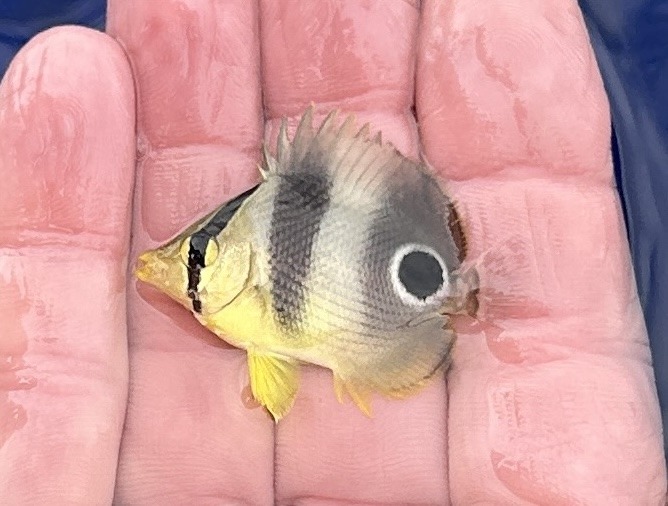
I ended up leaving with 17 angelfish and a foureye butterflyfish – more than I could possibly keep. However, between social media posts and some direct communications over the course of the weekend, Plenty of people knew I had fish to spare, so it was not difficult to find homes for them (I mean, who doesn’t want a free angelfish?). I intended to keep only one pair of queen angels, the two French angels, and the butterfly fish. The rest were distributed to friends at various facilities including the Southampton High School Marine Science Lab, the NOAA Fisheries Lab in Beaufort, NC, and a couple of public aquariums. As of this writing, my fish are split between my fish room and the Carteret Community College Aquaculture lab. My plan is to get them to breeding size and try my hand at raising their larvae some day.









Todd,
Thank you for a thoroughly remarkable and enjoyable review of your past and more recent exploits documenting the various aspects of Long Island’s warmwater strays. I know of no one who has dedicated more time to that phenomenon.
Good work,
Howard