

The 3rd Asia Clownfish Competition (China) 2025 marked an important milestone for the China International Pet Show (CIPS): for the first time, a clownfish competition of this level was staged inside Asia’s most important aquarium trade show.
This was far more than a display of rare or flashy specimens. It was a true technical and cultural exchange, where selective breeding, genetics, aesthetics, and presentation all came together in a format with clear international ambitions.
As official media partners, we had direct access to the competition area and were able to document not only the winners, but the broader story of the event through detailed photography and a complete video report, including footage of the competing fish in motion.
Video Report: Clownfish in Motion
Before getting into categories and winners, we recommend watching our video report from CIPS 2025.
By following the chapter index, you can observe the competing clownfish swimming in their tanks, which helps reveal posture, confidence, movement, and overall presence—qualities that a still photo can only capture in part.
Static images tell the story of form. Movement reveals the rest.
In this article:
- Video Report: Clownfish in Motion
- The Three Official Competition Categories
- Percula Category: winners and gallery
- Ocellaris Category: winners and gallery
- Open Category: where the future of breeding takes shape (Recommended)
- The Jury: criteria and international members
- Conclusions and full gallery
The Competition Categories
The competition was divided into three official categories, each with its own judging logic:
- Percula Clownfish Group (Amphiprion percula)
- Ocellaris Clownfish Group (Amphiprion ocellaris)
- Hybrid / Wild / Open Group
This structure shows how advanced modern clownfish breeding has become. Top breeders are now working with highly refined genetic lines, maintaining clear standards
among fish that may look superficially similar to the untrained eye.
Percula and Ocellaris: Only Similar at First Glance
In everyday hobby language, Amphiprion percula and Amphiprion ocellaris are often mixed up. In a competitive setting, however, that distinction is essential.
The percula (Amphiprion percula) is judged largely on the cleanliness and strength of the standard: thicker, denser white bars, crisp edges, stronger black contrast, and a pattern that remains balanced without visual “bleeding.” Beyond the pattern, judges also look for a compact body shape, harmonious proportions, and fin continuity, all of which help create a cohesive and solid overall profile. Just as important is tank posture: stance, composure, and swimming control are part of the final impression.
The ocellaris (Amphiprion ocellaris), although from the same genus, follows a different logic in terms of contrast, body reading, and pattern distribution.
Separating the categories means respecting the genetics and breeding history of each line, an approach that reflects the maturity and discipline of the most advanced Asian breeding culture.
Percula Category – Classic Elegance, Modern Interpretation
Winner of the Percula Category

The winning percula (Amphiprion percula) offered an especially refined interpretation of the classic standard, but with a distinctly modern feel. The first impression is one of balance across the entire fish: harmonious structure, clean symmetry, and the kind of tank presence that suggests maturity and composure.


The pattern is intense and sharply defined, with strong contrast and a distribution of color that enhances the fish without pushing into excess. It is a percula that wins not through spectacle, but through overall coherence, and that is exactly what the judges appear to have rewarded.
In the CIPS 2025 video report, this fish can be seen in motion, where its posture and swimming control become even more convincing.
Third Place – Character, Presence, and Identity
The third-place fish in the percula category (Amphiprion percula) stands out for personality and presence. Its structure is compact, the fins are well developed, and the overall body proportions immediately communicate stability.
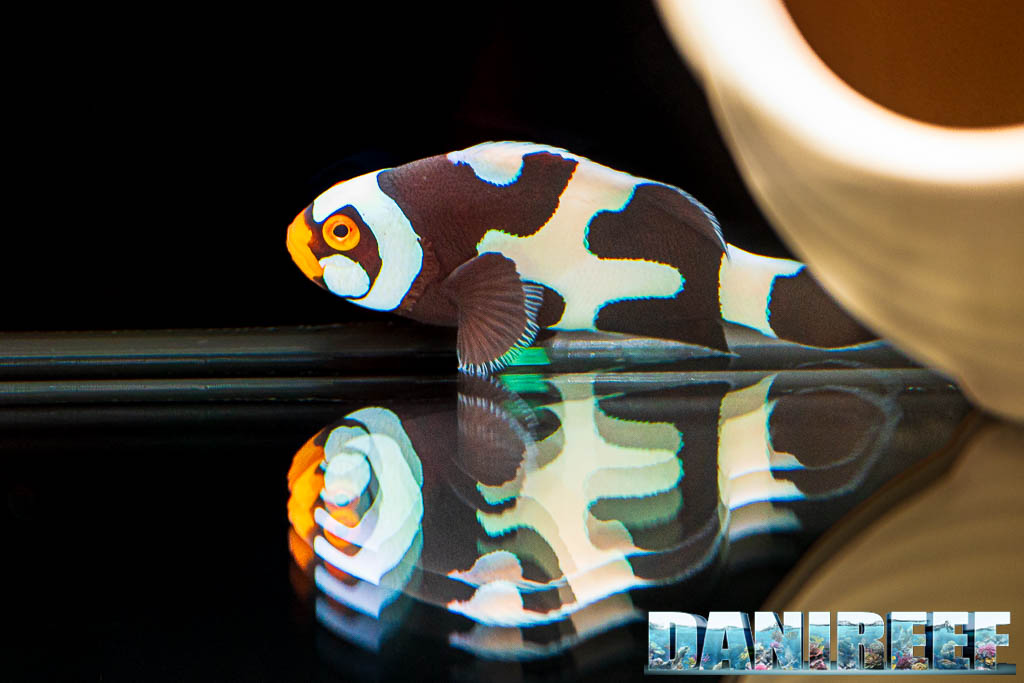
The coloration remains within traditional boundaries, but the contrast is handled with care and the overall finish is uniform and mature. This is a fish whose value lies in technical solidity and continuity, rather than instant spectacle.
High-Level Percula: When the Podium Doesn’t Tell the Whole Story
In this edition of the 3rd Asia Clownfish Competition, the percula category (Amphiprion percula) showed an impressively high overall level. Not every awarded specimen remained on display during our coverage, but the quality across the class was impossible to miss.
In the gallery below are some of the most representative fish from the competition, selected to illustrate the technical depth and stylistic range of this category.


The percula shown here reflect strong attention to morphology, clean patterning, and proportional balance, confirming that even classic lines can remain extremely competitive when supported by coherent long-term breeding.
The Winner of the Ocellaris Category
Ocellaris Clownfish Group – 1st Place

The winning ocellaris (Amphiprion ocellaris) perfectly captures the standard favored in this category.
What stands out immediately is the absence of classic bars, replaced by spots, along with the depth of color, the overall body symmetry, and a tank posture that communicates calm control and confidence.
This is not simply an attractive fish. It is the result of years of disciplined selection, where morphology, pattern, and even behavioral response have all been carefully shaped.


In the video report, this fish can be seen alongside the other finalists, making it easier to appreciate the qualities that set it apart for the judges.
Second Place – Excellence at the Highest Level
The second-place ocellaris (Amphiprion ocellaris) is another example of elite breeding, capable of challenging the winner all the way in an extremely selective class. The structure is strong and balanced, the profile reads immediately, and the especially developed fins give this fish a distinctive and highly valuable identity.

The coloration is intense and clean, with sharp edges and well-managed contrast, reflecting careful and mature genetic work. In another year, or in a slightly less competitive field, this could easily have been a first-place fish.
Third Place – Consistency, Cleanliness, and Aesthetic Maturity
The third-place ocellaris (Amphiprion ocellaris) offers a more understated but extremely consistent interpretation of the standard. It stands out for the cleanliness of the pattern, a strong relationship between body and fins, and a composed, elegant tank presence.

The color decisions and pattern layout show real aesthetic maturity, rewarded by the judges for balance and continuity. It is an ocellaris built not on excess, but on the overall quality of the whole fish.
Top-Level Ocellaris Beyond the Podium
Stopping at the top three would be misleading. The Ocellaris category of the 3rd Asia Clownfish Competition showed remarkable technical depth: near-perfect symmetry, extreme contrast, and morphological standards that would have seemed extraordinary only a few years ago.
In the following gallery are several additional fish that demonstrate just how high the average level was.


Open Category: Where Breeding Becomes Research
Open / Hybrid / Wild Group – genetic freedom and vision
The Open category of the 3rd Asia Clownfish Competition may be the clearest window into the current state of high-end Asian clownfish breeding.
There are no rigid species boundaries here. The Open class is where controlled hybridization, extreme selection, and individual aesthetic vision coexist in the same competitive space.
This is the category in which breeders are no longer simply trying to reproduce an accepted standard, but to push it forward, working on:
- unconventional patterns
- new chromatic relationships
- the balance between form, color, and behavior
Not surprisingly, this is also the category that asks the most of the judges, because it requires a broader, more holistic reading of the fish.
Winner of the Open Category
Winner of the Open Category – Interpreting the Future
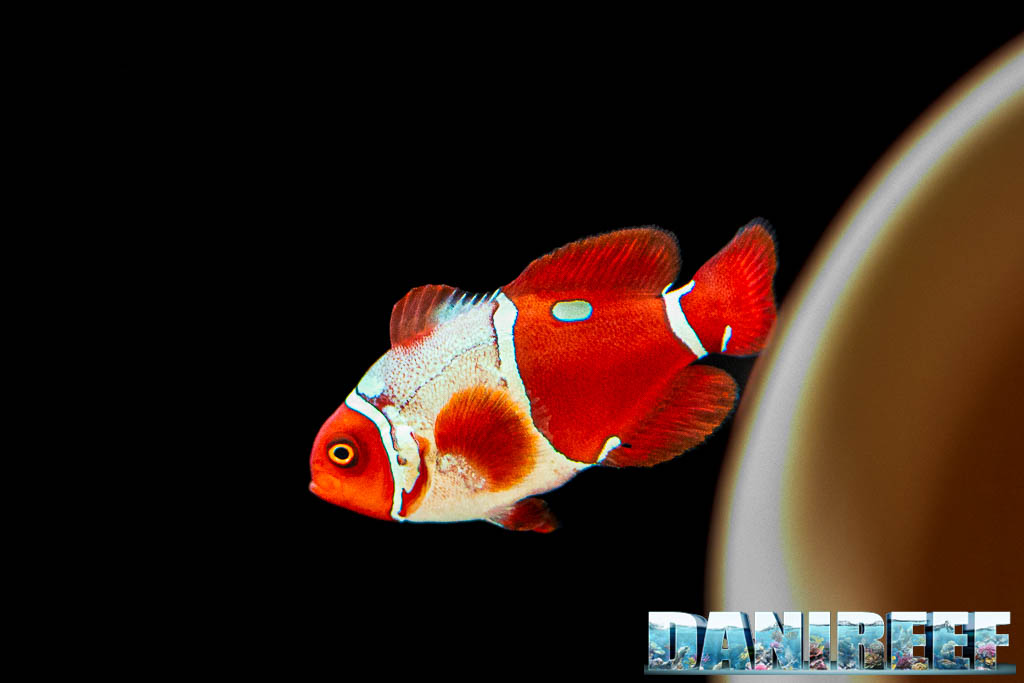
The fish awarded 1st place in the Open category captures exactly what this class is about: not excess for its own sake, but genetic coherence, visual balance, and design maturity.


The pattern breaks from classic expectations, but with internal logic; the coloration is intense without becoming chaotic; the body remains structurally clear and strong, which tells us that behind the look there is long-term breeding work, not just an isolated mutation.
In the video report, this fish can be seen swimming with the other finalists in the category, reinforcing the sense of completeness that appears to have impressed the judges.
Other Fish from the Open Category
In the Open class, not all fish remain on display through the end of the event. Some are sold, some are transferred, and some are withdrawn by breeders shortly after the awards. For that reason, it is more accurate to speak not only of a podium, but of a broader group of awarded and standout specimens that represented the spirit of the class.
The other fish highlighted by the judges stood out for:
- controlled genetic experimentation
- strong visual identity
- balance between innovation and structural stability
They show that the Open category is not a break from standards, but the place where future standards are often born.


In the gallery above, you can see a selection of some of the most interesting fish from the Open category, chosen not strictly by placing, but by quality, originality, and evolutionary potential.
The Open category sends a clear message: modern clownfish breeding is no longer only about perfecting what already exists, but about imagining what comes next.
It is very likely that some of the patterns and bloodlines seen here will influence more traditional contest standards in the years ahead.
The Jury: International Expertise in Service of the Standard
One of the elements that gave this edition further authority was the composition of the international jury, tasked with evaluating the fish through a rigorous, multi-layered lens.
Evaluation Criteria
The jury scored the fish based on:
- overall health
- color quality
- morphological symmetry
- rarity of the line
- overall presentation in the tank
Jury Members
Ken Kwan – Singapore
Senior public-aquarium curator with extensive experience in large display systems, exhibit design, and the management of rare aquatic species.
Liam – Taiwan, China
Manager of the STB Clownfish brand and a well-known breeder in the field, recognized for developing select lines and supplying rare clownfish to the international market.
George Mavrakis – United States
Aquatic media personality with over a million followers and founder of Aquashella. He represents a modern form of aquarium communication, combining technical knowledge with wide public reach.
A First Edition That Sets a New Standard
Bringing a clownfish competition of this level into CIPS for the first time means formally recognizing the central role that selective marine breeding now plays in Asia.
This is not only about beauty or commerce. It is about aquarium culture, long-term vision, and deep respect for genetics, presentation, and refinement.
The competition also made clear something that many outside Asia are only beginning to fully appreciate: the region is not simply producing large volumes of fish, but increasingly setting the pace in terms of quality, selection, and aesthetic direction.














0 Comments