
Now here’s a critter with a story! Once used as currency, cowries are now popular additions to our aquariums. But you’ll have to choose wisely if you’d like to keep one: many cowries either eat your corals or starve in captivity. Sometimes both. Why? And which cowrie should you pick to avoid trouble?
The cowrie question
Why aren’t cowries all over our reef tanks like turbo snails and Nassarius? The main reason is that most are sponge specialists rather than expert algae munchers (although as we’ll see, there are exceptions). And if there’s one thing we aquarists aren’t good at yet, it’s keeping obligate spongivores alive. Sponge-eating fish like the emperor angelfish are generally quite adaptable, but the same thing can’t be said for invertebrates. It’s sponges or nothing—usually very specific types of cryptic sponges that we have neither identified nor learned how to grow yet.
Although various sponge-eating cowries pop up in shipments for the marine aquarium trade, these usually go the same way that spongivore starfish like Fromia and Linckia do: nowhere. They may starve slowly, but starve they will.
Where does that leave us? Luckily, it’s not all bad. There are a few cowries willing to branch out beyond sponges, and there’s even an entire genus of small specimens that does feed mostly on algae. Below, let’s take a look at what the family Cypraeidae has to offer us.
Green flag: Cowries for your reef
Money cowrie (Monetaria moneta)
Adult size: Up to 3 cm (1.18”)
Min. tank size: 5+ gallons
Diet: Algivore
Money doesn’t grow on trees, but apparently it does grow on tree corals. One of the smaller of its kind, the money cowrie is a proven algae eater that can make a great addition to your marine janitorial crew. It’s still commonly referred to as Cypraea moneta, but was actually moved to the genus Monetaria in 2003 during a big taxonomical shake-up of the cowrie family. Like all cowries, it’s mostly nocturnal, moving out into the open at night to scrape edible bits off your tank’s rocks and glass.
Like most of the small, algae-eating molluscs we keep in our tanks, money cowries are “set-and-forget” pets. Since they naturally occur in tide pools and intertidal zones—habitat types that are not for the weak—they’ll do well in the smallest of desktop reefs. All you have to do is enjoy your cowrie’s lovely yellow shell and the psychedelic striped pattern on its mantle.

Gold ring cowrie (Monetaria annulus)
Adult size: Up to 2.5 cm (1”)
Min. tank size: 5+ gallons
Diet: Algivore
It’s not easy to tell the difference between a money cowrie (see above) and a gold ring cowrie. The two are closely related and their shell colors and patterns vary widely—both can in fact sport yellowish rings, or not. The main difference is in the shape of the shell, with money cowries being more angular (rhomboid) while gold rings look like smooth eggs (ovoid).
No reason to bring a magnifying glass to your LFS: it really doesn’t matter which species you end up with. Both are excellent algae eaters with an added taste for detritus and will leave your corals alone. As long as there’s enough gunk in the tank for them to feed on, everything else will fall into place.
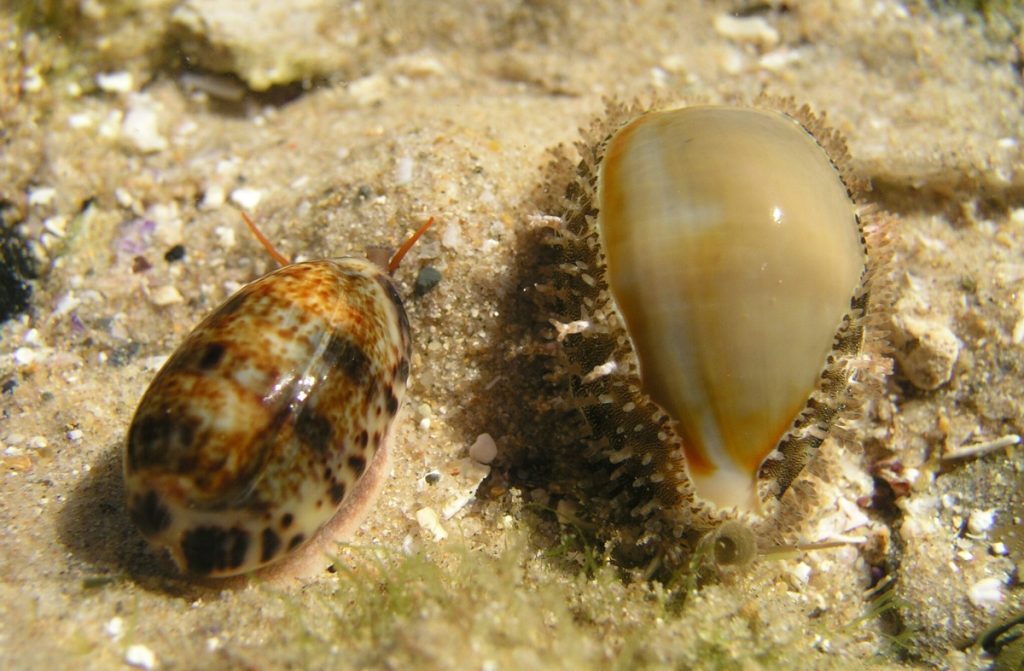
Snakehead cowrie (Monetaria caputserpentis)
Adult size: Up to 3.5 cm (1.4”)
Min. tank size: 5+ gallons
Diet: Algivore
Talk about a controversial cowrie. Some aquarists swear by the snakehead as an algae eater champion, while other sources list it as carnivorous and not reef-safe at all. This seemed odd to me given that Monetaria cowries are mostly dirt busters, so I dove into the literature to get a more definitive answer. Good news: no scientific sources list this cowrie as being a meat eater, even in adulthood. The confusion may be down to the fact that this species was formerly thought to belong to the genus Cypraea, which definitely does have a taste for sponges and corals.
If you need an addition to your reef’s janitorial night shift, you may go forth and purchase this decorative speckled cowrie (it reminds me of a coffee bean!) without worry. It’s less commonly available than the other Monetaria species, but will pop up in shipments now and then.
Orange flag: Cowries for FOWLR tanks
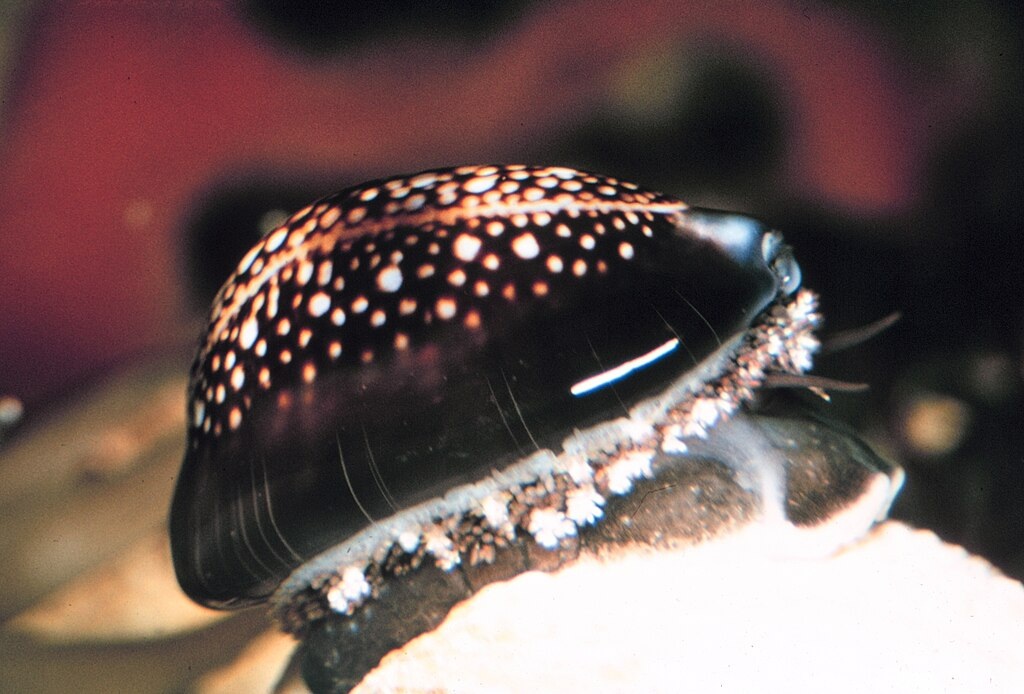
Tiger cowrie (Cypraea tigris)
Adult size: Up to 15 cm (6”)
Min. tank size: 50 gallons*
Diet: Algivore to carnivore
The cowrie everyone wants to keep, but few are willing to accommodate! Tiger cowries grow significantly larger than the aforementioned Monetaria species. With this size increase also comes an increase in voracity: although they’re mostly vegetarian when small, tiger cowries switch to a carnivorous diet in adulthood. Their favorite foods are sponges, but unlike most other cowries, they’re flexible and will branch out to corals and anemones.
Most aquarists report SPS corals being safe in a tiger cowrie tank. LPS generally get an orange flag (they may be bulldozed by this large snail), while soft corals are out of the question. Whatever the case, regular target feeding goes a long way in keeping both the snail and any corals alive.
Once your tiger cowrie reaches a length of ~2.5”, you’ll likely see it zooming around the tank in search of algae less and less frequently. At this point, particularly if you’ve seen it going after sessile invertebrates like pineapple sponges or Aiptasia/majano anemones, place a piece of clam or shrimp meat in front of the cowrie every week or so. If it sticks out its proboscis and starts eating, congratulations! Your tiger cowrie is now an adult and will require supplemental feeding two to three times a week.
*Aquarists disagree widely on minimum tank size for tiger cowries. I see folks pushing it with 20 gallons and others recommending 100—middle ground seems best.
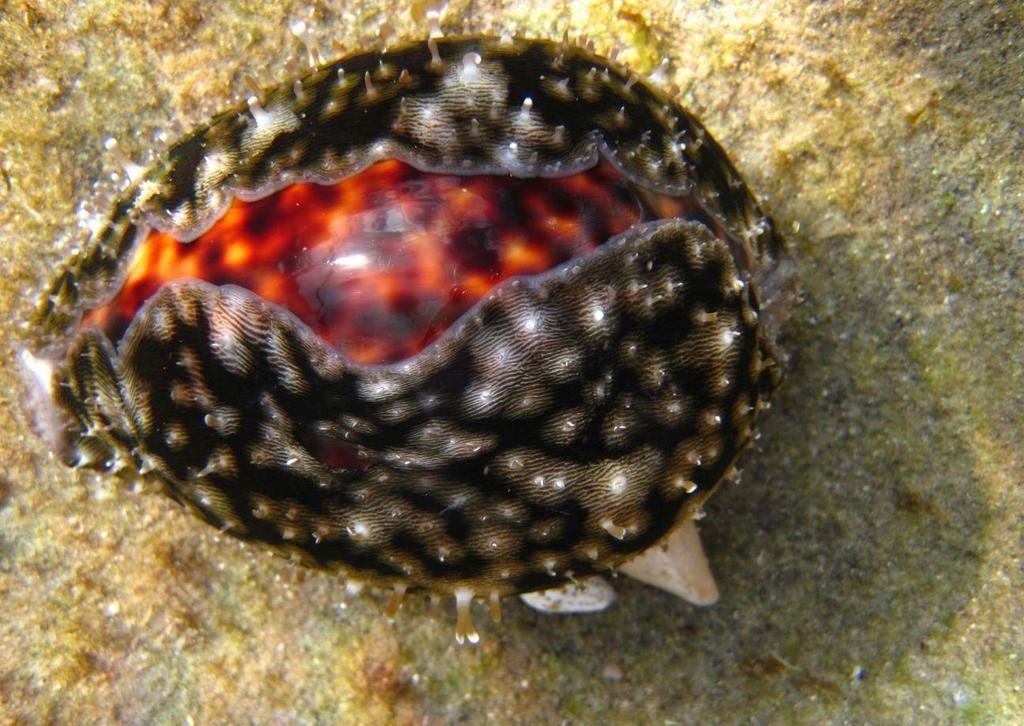
Arabian cowrie (Mauritia arabica)
Adult size: Up to 10 cm (5”)
Min. tank size: 40 gallons
Diet: Omnivore
Here’s the funny thing about cowries: everyone wants a tiger, but most should really get an Arabian. The former is a coral-hungry tank, while the latter mostly retains its love for algae into adulthood and maxes out at a more manageable adult size. A 2023 experiment that raised both in captivity states: “Juvenile C. tigris are herbivorous and feed on algae, while the carnivorous adults feed on sponges and corals (…) [M. arabica] is an omnivore feeding on algae and small invertebrates.” And it’s nice to look at, too!
Mind you, Arabian cowries are not vegetarians—the researchers fed their subjects a combination of prawn meat and cucumber—but they can go on the books as “tentatively reef safe” rather than “absolutely never let this get anywhere near a reef”. In large systems where algae and biofilm is abundant, you can probably get away with a weekly offering of prawn meat. In smaller aquariums, feeding more frequently and including blanched vegetables or nori is probably a good idea.
A note to aquarium importers
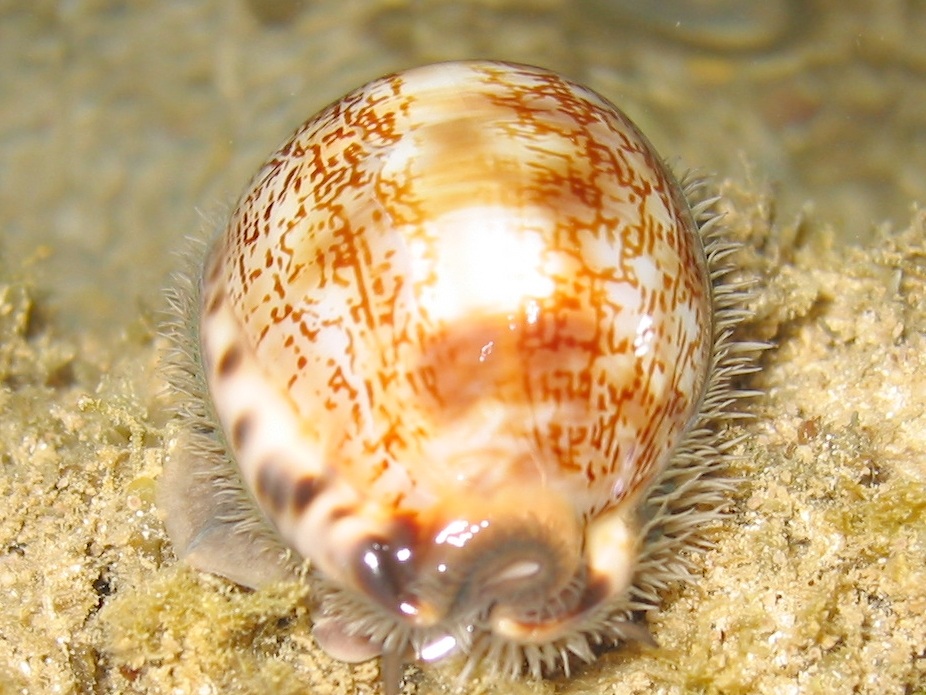
Erronea errones, the wandering cowrie, is listed by researchers as an algae eating champion with no taste whatsoever for corals. Missed opportunity. When can I buy one?
Sources
Hayes, T. (1983). The influence of diet on local distributions of Cypraea.
Passamonti, M. (2015). The family Cypraeidae (Gastropoda Cypraeoidea) an unexpected case of neglected animals. Biodiversity Journal, 6(1), 449-466.
Tay, T. S., Lee, H. R. S., & Neo, M. L. (2023). Spawning and larval development of two tropical cowries (Gastropoda: Cypraeidae), Cypraea tigris and Mauritia arabica under laboratory conditions. Royal Society Open Science, 10(4).











0 Comments