
Ever sat in front of your tank squinting, trying and failing to ascertain whether that blotch on your Acropora is a parasitic flatworm or just discoloration? Or maybe trying to take a photo of your favorite coral, only for it to turn out looking like you used a potato rather than a camera to snap the shot? Struggling to spot tiny critters? You catch my drift: sometimes it’s hard to see what’s going on in your reef.
Don’t worry! Fellow reef keepers have already come up a great solution. It’s called a reef magnifier, and it’s one of my favorite must-have aquarium gadgets to get for yourself or gift to the fellow reef keepers in your life.
What’s a reef magnifier, anyway?
Reef magnifiers have actually been around for a while. We’ve posted about them before here at Reefs.com, like in Marc’s Reef Diary #116, but I still think these gadgets are underappreciated. So let’s have a closer look, shall we (pun intended)?
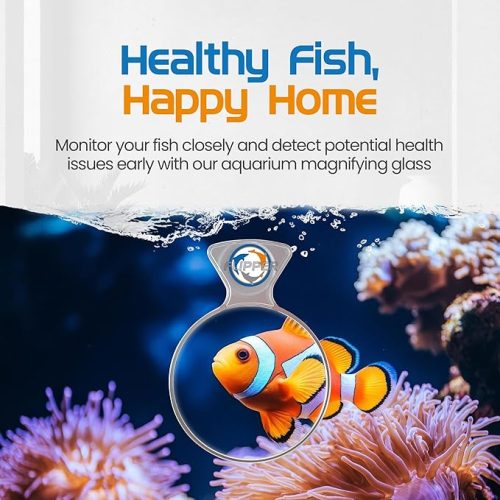
As the name suggests, these are magnifying glasses. Not hand-held ones, but a special design for reef tanks that sticks to the glass—and can be moved around whenever you like, because the magnifier is secured using magnets. These devices magnify 3x and the focal range is between 2-12″ depending on which model you choose. Everything located between those distances from the optical-grade lens will be both magnified and in focus. Let’s see those pests trying to fly under the radar now!
Reef photography
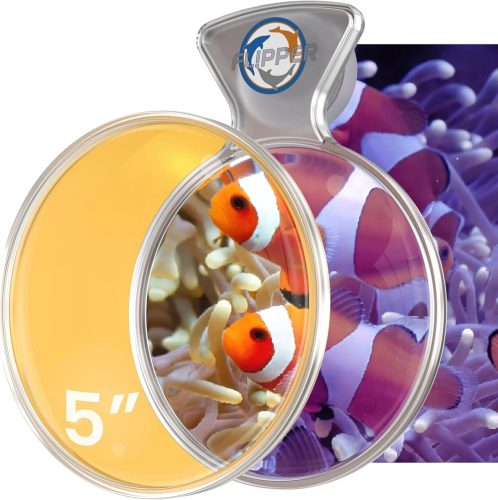
If you like taking photos and were thinking these reef magnifiers sound interesting for photography purposes, you’re totally right. Today will be the day you finally manage to take a proper shot of those tiny sexy shrimp—maybe even something as small as a copepod. Reef magnifier brands also realized this potential, and they’ve developed a way to take it to the next level with colored filters (which can be purchased separately).
Even less experienced photographers will have noticed that everything you snap in a reef tank comes out extremely blue, even more so than when you’re just looking at it with your eyeballs rather than a camera. This is due to the actinic lighting, which obliterates most red or yellow tones and mostly leaves blues, purples, and greens. It makes our corals look fantastic, but ruins our attempts to take photos of them.
The solution? Well, you can adjust the image’s warmth in post-processing, but you may not manage to add enough reds and yellows back in to get it to your liking. Best to put them back in before you take the pic, and that’s where the filters come in. With their orange-yellow to fully orange hue, they’re perfect for counteracting the blueness of the actinic lighting. Just flip the filter in front of the magnifier and don’t be scared of how orange it looks. Try taking a photo and you’ll notice how suddenly you can see the true hues of your fish and corals again, rather than just a blue mass!
Which reef magnifier should I get?
When choosing a reef magnifier, you’ve basically got two brands to choose between: the Flipper DeepSee and Maxspect Pastel Reef Magnifier. Which one you end up going for depends on your exact needs.
My personal winner is the DeepSee, and not just because of the punny name—I like how it integrates with Flipper algae cleaning products, and the company is located in the USA.
| Flipper DeepSee | Maxspect Pastel Reef | Notes | |
| Lens sizes available | 3”, 4”, 5” (Nano, Normal, Max) | 4.5”, 5.5” (Standard, Grande) | Actual device size is larger. For very small tanks, check whether the magnifier actually fits! |
| Focal ranges | 2-6”, 3-8”, 3-12” | 3-8” for both | Anything in this range will be in focus. |
| Colors available | Black, clear | Black | |
| Max. glass thickness | 10 mm (⅜”), 16 mm (⅝”), 20 mm (¾”) | 15 mm (½”), 20 mm (¾”) | |
| Magnification | 3x | 3x | |
| Replacement magnet available? | Yes | No | |
| Anything else? | Felt lining for smooth movement, compatible with Flipper algae cleaner line | Built-in softbox light | Flipper is located in California and is slightly more expensive; Maxspect in Hong Kong and is a little cheaper. |
Tip: I like the permanent magnifiers most, but there are also portable brands, such as the ReefBrite Aquaviewer. Not great for photography, but definitely useful for keeping an eye on your critters.
- Detailed Underwater Viewing: The 4″ optical-grade lens offers distortion-free magnification with a focal range of 3 to 8 inches, bringing corals, fish, and aquarium details into sharp focus.
- Powerful Magnetic Design: Equipped with strong rare-earth magnets that hold securely to glass or acrylic up to 5/8″ thick, allowing smooth, hands-free repositioning for clear underwater viewing.
- Ideal for Coral & Fish Observation: Designed for monitoring coral health, spotting small details, or setting up close-up photography, allowing clear viewing of aquarium life.
- Durable & Secure Build: Rare-earth magnets ensure a strong, stable hold, while the optical acrylic lens provides clear visibility and lasting performance on both glass and acrylic surfaces.
- Built with durable materials and precision engineering, the DeepSee 4″ magnifying glass provides reliable, long-lasting performance and clear underwater viewing for aquarium enthusiasts.












0 Comments