
Researchers at the University of California, San Diego’s Scripps Institution of Oceanography and the Jacobs School of Engineering have developed a gel that increases coral larvae settlement.
The gel, called SNAP-X, is applied to surfaces and uses nanoparticles to slowly release a “smell” that mimics a healthy coral reef and attracts coral larvae to settle there. In lab experiments, coral larvae settlement increased by up to 20 times versus untreated surfaces, and the gel releases the coral-attracting chemicals for up to a month at a time.
“Coral are animals, and their larvae are selective about where they are going to attach because once they do, they’re stuck there,” said Daniel Wangpraseurt, the study’s senior author and a marine biologist at Scripps with a previous appointment in UC San Diego’s Department of Chemical and Nano Engineering. “With SNAP-X, we created a material that releases chemical cues that tell coral larvae this is a good place to live.”

Marine biologist Daniel Wangpraseurt (left) and postdoctoral researcher Samapti Kundu examine coral growing in an experimental aquarium at UC San Diego’s Scripps Institution of Oceanography.
Credit: Erik Jepsen/UC San Diego
Coral reefs have an estimated economic value of $375 billion, but over 80% worldwide are currently threatened by an unprecedented bleaching event. Corals are projected to decline by 70-90% at 1.5 degrees Celsius (2.7 degrees Fahrenheit) of warming relative to preindustrial times, and by 99% at 2°C (3.6°F).
Settlement is one of the most difficult parts of coral sexual reproduction, and reef restoration scientists have found that coral larvae don’t like to settle on degraded reefs or man-made reef structures, which don’t smell like a natural, thriving reef. Furthermore, degraded coral reefs can even deter larvae from settling, compounding the problem of restoring damaged reefs to their former glory.
CCA
Coral spawning scientists know that crustose coralline algae (CCA for short) release chemicals that encourage baby corals to attach to surfaces. SNAP-X features the same chemical cues, but the double break through is that it is in gel form that can be applied to hard surfaces, instead of just dissipating and floating away in the ocean.
The gel can be sprayed or painted-on when wet, but then hardened under UV light, enabling controlled slow release after spawning events.
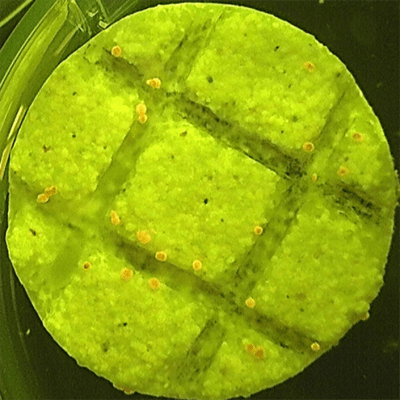
Coral larvae settling on substrate coated with SNAP-X. Image from Coral Reef Ecophysiology and Engineering Lab
“I think this material is a breakthrough that can hopefully make a big contribution to coral restoration,” said Wangpraseurt. “Biomedical scientists have spent a lot of time developing nanomaterials as drug carriers, and here we were able to apply some of that knowledge to marine restoration. This paper highlights that if you bring together ideas from different scientific fields, you can create innovative solutions to tough problems like restoring coral reefs.”
The research is published in Trends in Biotechnology, and was conducted with funding from the Defense Advanced Research Projects Agency’s Reefense program.








0 Comments