



You are using an out of date browser. It may not display this or other websites correctly.
You should upgrade or use an alternative browser.
You should upgrade or use an alternative browser.
What is this?
- Thread starter WannaBeReefer
- Start date

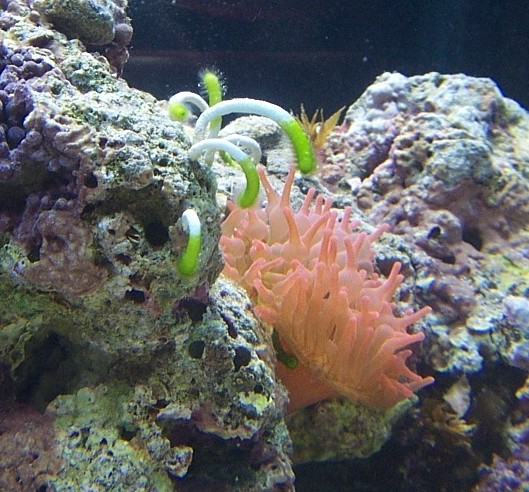
Gresham, Neomeris seems to be fairly common on uncured live rock but doesn't seem to last long in aquariums. It might be because it's tempting and easily eradicated by herbivores. It does secrete carbonate, especially towards the base.

Inter-Research Marine Ecology Progress Series
MEPS 134:49-58 (1996) Abstract
Effects of secondary metabolites and CaCO3 on feeding by surgeonfishes and parrotfishes: within-plant comparisons
Pennings SC, Puglisi MP, Pitlik TJ, Himaya AC, Paul VJ
ABSTRACT: Tropical seaweeds and 'plant-like' animals often contain both secondary metabolites and high concentrations of minerals. Typically, secondary metabolites are most concentrated in the tip of the organism and minerals in the base. We used within-individual variation in defenses in the alga Neomeris annulata to test the hypothesis that surgeonfishes are deterred from feeding by calcium carbonate but not by chemical defenses, whereas parrotfishes are deterred from feeding by chemical defenses but not by calcium carbonate. Our results supported this hypothesis. The parrotfish Scarus sordidus preferred to feed on an artificial food containing CaCO3 compared to control food, but preferred control food over food containing a sesquiterpene-rich organic extract of N. annulata. Two species of parrotfishes fed primarily on the metabolite-poor, CaCO3-rich basal regions of N. annulata, whereas 2 species of surgeonfishes fed primarily on the metabolite-rich, CaCO3-poor tips. Variation in grazing location had important consequences for N. annulata. Individuals grazed on the tips grew in length more slowly than individuals grazed around the base. Individuals grazed on the tips were temporarily rich in CaCO3; individuals grazed around the base were temporarily rich in sesquiterpenes. These patterns were probably not a result of induction of defenses, but rather a consequence of selective removal of CaCO3-poor and sesquiterpene-poor material respectively.
Copyright © Inter-Research, Oldendorf/Luhe, 1996
Inter-Research Marine Ecology Progress Series
MEPS 134:49-58 (1996) Abstract
Effects of secondary metabolites and CaCO3 on feeding by surgeonfishes and parrotfishes: within-plant comparisons
Pennings SC, Puglisi MP, Pitlik TJ, Himaya AC, Paul VJ
ABSTRACT: Tropical seaweeds and 'plant-like' animals often contain both secondary metabolites and high concentrations of minerals. Typically, secondary metabolites are most concentrated in the tip of the organism and minerals in the base. We used within-individual variation in defenses in the alga Neomeris annulata to test the hypothesis that surgeonfishes are deterred from feeding by calcium carbonate but not by chemical defenses, whereas parrotfishes are deterred from feeding by chemical defenses but not by calcium carbonate. Our results supported this hypothesis. The parrotfish Scarus sordidus preferred to feed on an artificial food containing CaCO3 compared to control food, but preferred control food over food containing a sesquiterpene-rich organic extract of N. annulata. Two species of parrotfishes fed primarily on the metabolite-poor, CaCO3-rich basal regions of N. annulata, whereas 2 species of surgeonfishes fed primarily on the metabolite-rich, CaCO3-poor tips. Variation in grazing location had important consequences for N. annulata. Individuals grazed on the tips grew in length more slowly than individuals grazed around the base. Individuals grazed on the tips were temporarily rich in CaCO3; individuals grazed around the base were temporarily rich in sesquiterpenes. These patterns were probably not a result of induction of defenses, but rather a consequence of selective removal of CaCO3-poor and sesquiterpene-poor material respectively.
Copyright © Inter-Research, Oldendorf/Luhe, 1996
Sponsor Reefs
We're a FREE website, and we exist because of hobbyists like YOU who help us run this community.
Click here to sponsor $10: