
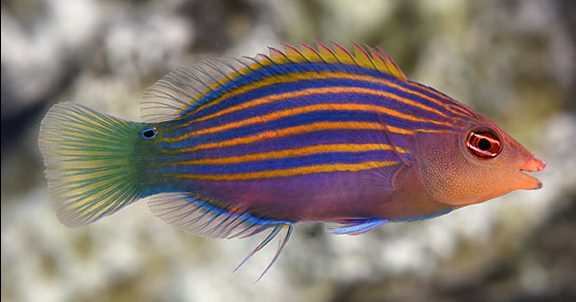
The Six Line Wrasse is both beautiful and active. With its six distinct, horizontal blue lines overlaid against an orange body, this member of the Labridae family brings a zip of color to any marine reef aquarium. This is especially true when a courting male Six Line Wrasse displays an increased color intensity. However, it is the active darting amongst rock outcroppings and corals that most attracts the Six Line Wrasse to any onlooker.
Also known as the Sixline or Sixstripe Wrasse, Pseudocheilinus hexataenia is native to reefs of the Indo-Pacific and the coast of Fiji. Here, the Six Line Wrasse forages amongst corals and rocks for foods, mainly keeping to itself. In the home aquarium, the Six Line Wrasse requires a peaceful environment with a generous supply of hiding places and live rock on which they can forage for food. Here, the Six Line Wrasse will search for live foods in the form of small crustaceans such as pyramidellid snails (clam parasites), urchins, and commensal flatworms. The Six Line Wrasse is also known to feed on unwanted pests on live rock, such as bristleworms.
Though generally peaceful, the Six Line Wrasse may act aggressively towards peaceful Wrasses and other easily-intimidated fish, especially if inadequately fed or if its habitat is void of places in which it can hide.
The Six Line Wrasse diet should include vitamin enriched frozen mysis shrimp, vitamin enriched frozen brine shrimp, and other meaty foods along with a high quality marine flake and marine pellet food.
The Six Line Wrasse is also referred to as the Sixline Wrasse or Sixstripe Wrasse. It has six, horizontal distinctive blue lines lying against an orange background. When courting, the male will display an increased color intensity. It requires a 30 gallon or larger aquarium with a generous supply of hiding places and live rock in which to forage for food. It may act aggressively towards peaceful Wrasses and other fish that are easily intimidated. It will search for live foods in the form of small crustaceans such as pyramidellid snails (clam parasites), urchins, and commensal flatworms. Six Line Wrasse are also known to feed on unwanted pests on live rock, such as bristleworms. When first introduced into the aquarium, live saltwater feeder shrimp should be used to entice this fish to eat. The diet should consist of finely chopped meaty foods and occasionally vitamin-enriched frozen preparations.