
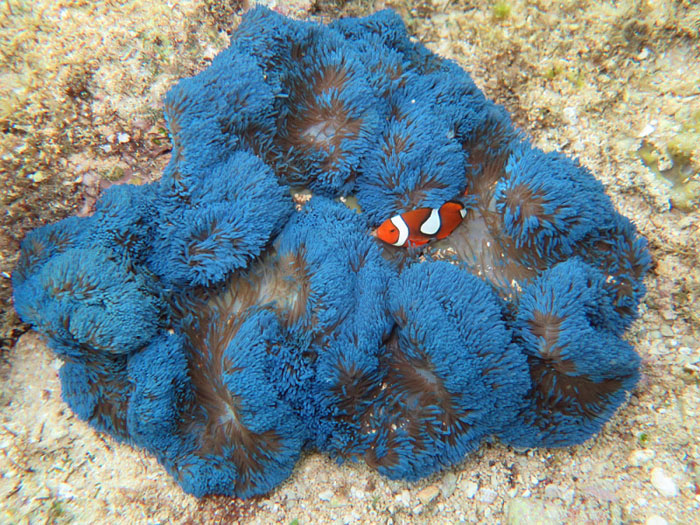
The Giant carpet anemone is very similar to Haddon’s carpet anemone, but it grows much larger, up to two and a half feet in diameter. It also has light spots on the underside of the oral disc and longer, pointed tentacles, while Haddon’s anemone has shorter, beaded tentacles. This species is the natural host of the most common clownfish in home aquariums such as Amphiprion ocellaris, A. percula, A. clarkii, A. perideraion, A. akindynos, A. rubrocinctus, and A. bicinctus. These anemones need a very large, established aquarium with perfect water quality, high flow, and bright lighting. It likes to bury its foot and column in sand and attach to a flat rock or the glass under the sand. Handle this species with gloves, as it has a powerful sting. Very large specimens should be handled with shoulder length gloves since the skin on the underside of your arms is more susceptible. This species is very aggressive, so give a minimum of a foot of space between a fully inflated Giant carpet anemone and any other anemones and corals. Feed at least weekly with chunks of frozen silversides, shrimp, squid, and other meaty foods for large carnivores. A healthy specimen will have a tightly closed mouth and will be very sticky. They tend to be pretty expensive, especially red or blue specimens.
The True Carpet Anemone has a wavy appearance, and lives singly, in the shallow waters of the Central Pacific, Indo Pacific and Red Sea. Normally found on rocky reefs with soft muddy or sandy substrate it can attain a size of up to three feet in diameter. This anemone is also referred to as the Carpet Anemone, Gigantic Sea Anemone, or Giant Carpet Anemone. It has relatively short, tapered tentacles with a milder sting than its close relative Stichodactyla haddoni . The True Carpet Anemone and can be distinguished from Stichodactyla haddoni by the rows of spots on the underside of the oral disc which stop at the column. This anemone serves as a "host" for many types of clownfish in the wild including: Amphiprion clarkii , A. perideraion , A. akindynos , A. rubrocinctus , A.barberi , A. bicinctus , A. ocellaris , and A. percula . The True Carpet Anemone requires a tank with very strong lighting and strong water movement. The aquarium should have a variety of sandy and rocky locations as this animal oftentimes can move about and seek refuge in a place it prefers. This species of Carpet Anemone prefers to bury its foot into the sandy bottom at the base of a rock, and it will oftentimes attach itself to the bottom of the aquarium glass, where its column is completely protected under a rock and in the sand for protection. When first introducing this anemone into the display, it is best to try and dig out an area of the sand bed at the base of a large rock where you prefer it will reside, while decreasing the flow rate for a brief period of time during so that it is not blown around the display. Doing so will allow the anemone time to settle in, so its pedal disc or foot can adhere to the rock where it is placed. Once in place, carefully move some sandy substrate around the column and increase the flow rate back to the normal output. The True Carpet Anemone has somewhat of a potent sting and may harm corals and other anemones as it moves about the aquarium. It is not compatible with other anemones within a 12" diameter, so monitor it when it is first introduced into the tank. This species of Carpet Anemone can eat fish in the display aquarium so use caution when housing a Carpet Anemone in with fish other than clownfish. When adjusted to the display aquarium, this anemone is very sticky to the touch, and when it grasps something (or someone), it is very difficult to convince it to let go without damaging the animal. It is also one of the few anemones that can cause a severe reaction in humans, especially when it comes in contact with areas of the skin that are more sensitive like the underside of the arms, or back of the hand. The True Carpet Anemone is one of the most challenging to maintain in the home aquarium, and is best left to only the most experienced, veteran aquarists. For proper care, a fully established aquarium, with perfect water chemistry, adequate water flow and strong illumination, along with weekly or even daily feeding is needed. Ideal foods consist of chunks of fresh fish, uncooked shrimp, large mysis shrimp and other meaty marine foods . Approximate Purchase Size When Fully Expanded: Small: 2-1/2" to 4-1/2"; Medium: 4-1/2" to 6"; Large: 6" to 8"; XLarge: 8" or larger Please note: We guarantee that ALL aquaria species we offer will arrive alive and in good condition. However, because of the increased level of care required for this particular species, it has been designated as "Expert Only." This species is recommended only for the expert aquarist, zoo, or research institution. “Expert Only” aquatic life is exempt from our extended guarantee after their arrival.
